
Hamilton Elite Roofing brings more than 20 years of roof repair experience to Hamilton, NJ homes and businesses, and we work across nearby towns including Robbinsville, Bordentown Township, Florence and Hopewell Township. Most of the roofs we are called to are not finished; they have one or two failures that let water in while the rest of the covering still has years left.
Our first job on any repair is diagnosis. We go onto the roof and into the attic, find the actual point of failure and photograph it, then tell you plainly whether a repair will hold. Replacement only comes up when patching would mean paying for the same problem again next season.
Roof repair covers more ground than shingles. Flashing at walls and chimneys, rubber pipe boots, ridge vents, valleys, skylight curbs and low-slope membranes all fail in their own ways, and each needs a repair built for that detail rather than a bead of roofing cement.
Residential Roof Repair
Asphalt Shingle Repair
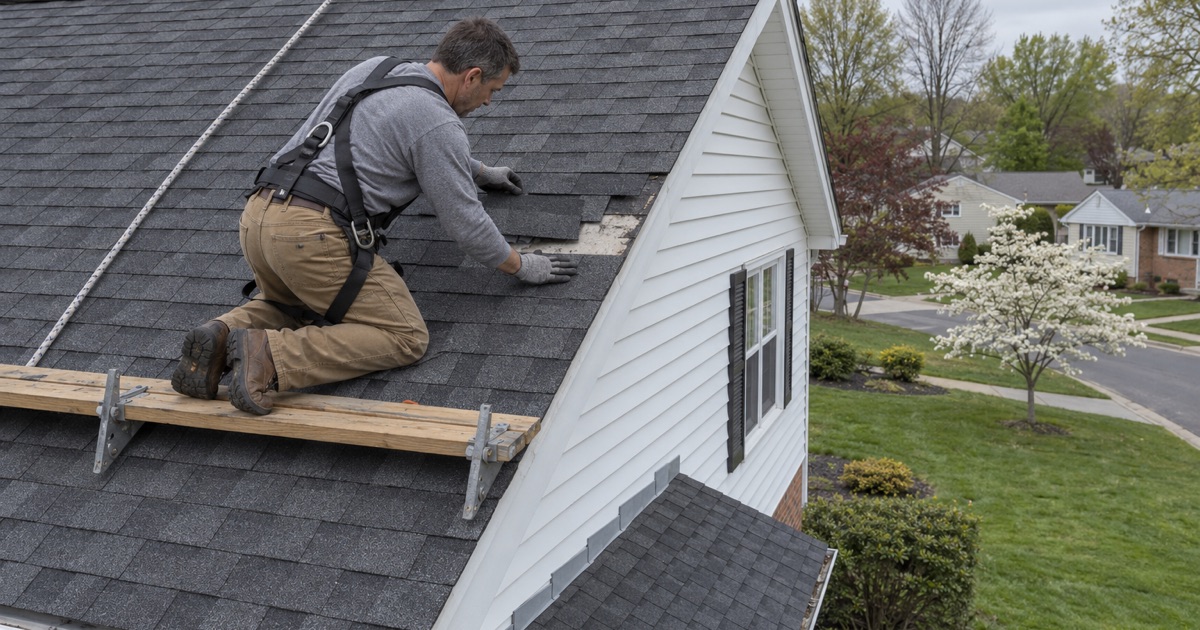
Wind lifts and creases shingles, nail pops push tabs up from below, and old shingles crack when they are bent in cold weather. We replace damaged shingles by breaking the seal on the courses above, sliding the new pieces in, nailing them properly and hand-sealing the surrounding tabs so the repair resists the next gust.
Matching matters on a visible slope. We work with the common architectural lines such as GAF Timberline HDZ, Owens Corning Duration and CertainTeed Landmark, and we tell you before we start how close the color is likely to be, so you can decide whether a patch on the front of the house is acceptable.
Flashing Repair at Walls, Valleys and Chimneys
Flashing is where most leaks begin. Step flashing along a sidewall, counter flashing set into a reglet on a chimney, apron flashing below a dormer and kick-out flashing where a roof edge meets siding all direct water away from a joint. When any of them rusts, loosens or was installed short, water runs behind it.
We replace failed flashing with new metal rather than smearing sealant over the joint. Sealant cracks within a few seasons as the roof expands and contracts; properly lapped metal sheds water for the life of the shingles around it.
Pipe Boots, Vents and Penetrations
Rubber pipe boots dry out and split in the sun, usually long before the shingles around them wear out. A split boot lets water run straight down the vent pipe into the attic. We replace them with new rubber or lead flashing boots sized to the pipe, and we check bath fans, attic vents and ridge vents for the same kind of failure while we are up there.
A leak at a penetration often shows up some distance from the pipe itself, because the water runs down the rafter or along the top of the drywall before it drips. That is why we confirm the path from the attic side, so the boot we replace is the one actually letting water in rather than the nearest one to the stain.
Slate Repair on Older Hamilton Houses
Roughly one in five Hamilton homes predates 1950, and some still wear slate. A slate roof often has decades left when only a few pieces are cracked or slipped. We replace them with matching slate fastened with copper nails and slate hooks, and we avoid walking the field of the roof in ways that crack sound slates around the repair.
The most common mistake we see on slate is a past repair made with asphalt shingles or a smear of tar over a cracked piece. Both trap water and speed up decay of the slates around them. Where we find that kind of patch, we remove it and restore the slate properly, which keeps a durable roof working instead of pushing the owner toward an early replacement.
Commercial and Low-Slope Roof Repair
Flat Roof Membrane Repair
Low-slope roofs on garages, porches, row homes and commercial buildings use membranes rather than shingles. Torch-down SBS and APP modified bitumen, EPDM rubber and TPO single-ply each have their own repair method, from torching in a cap sheet patch to cleaning, priming and adhering new EPDM over a split seam. We identify the membrane first, then use the material that bonds to it.
Ponding water is often the real cause of a flat roof leak. We check whether drains, scuppers and gutters are clear and whether the deck has sagged, and we tell you when a patch will hold and when the low spot will keep pulling water back through the same seam.
Storefront and Mixed-Use Buildings
On buildings with shops downstairs and apartments above, a roof leak becomes a tenant complaint within hours. We plan repairs around business hours and residents, look closely at parapet walls, coping and rooftop unit curbs where these roofs commonly fail, and document the repair so the owner has a record for the property file.
Commercial roofs along the Route 130 and I-195 corridor include large low-slope buildings. We size each repair to the roof in front of us and say clearly when a building needs a membrane specialist’s full replacement scope rather than another patch.
When Repair Is the Wrong Answer
Signs a Roof Is Past Repair
Some roofs are not worth patching. Shingles that crack when lifted, bare spots where granules have washed into the gutters, curling across entire slopes and soft decking under foot all mean the covering has reached the end of its life. A repair on that roof buys a few months at best.
When we reach that conclusion we show you the evidence, photographs and all, rather than simply quoting a replacement. You decide what to do with that information, and the repair option stays on the table if you need time to plan.
Repeat Leaks in the Same Spot
A leak that returns after two repairs usually means the diagnosis was wrong, not that the roof is beyond saving. Water may be entering higher up and running along the deck, or the cause may be condensation from a poorly ventilated attic. We trace the path from the attic side before we touch the roof again, so the next repair is aimed at the real source.
Two Layers and Hidden Damage
Many mid-century Hamilton houses carry a second layer of shingles over the first. Repairs on a two-layer roof are harder to seal because the new shingle sits on an uneven surface, and the old layer can hide rotted decking. We tell you when that condition makes a lasting repair unlikely, and we explain that under the New Jersey rehabilitation subcode the next re-roof will require a full tear-off.
Roof Repair Pricing, Paperwork and Scheduling
How a Roof Repair Is Priced
Repair pricing depends on what failed and how hard it is to reach. A few replacement shingles on a walkable rear slope cost far less than rebuilding chimney counter flashing on a steep front roof, and slate or flat roof repairs need different materials and time again. We price the specific repair we traced, in writing, before any work starts.
If the inspection turns up more than one problem, we list each separately and mark which are urgent and which can wait. That lets you fix the active leak now and plan the rest, instead of being handed one combined number that hides which part of the work actually stops the water.
Paperwork You Receive
Every repair comes with before and after photographs, a short written description of what we found and what we did, and the materials used. That record is useful when you sell the house, when an insurer asks about the roof’s condition, or when a later problem appears and you need to know what was already done.
Repair contracts follow the home improvement rules of New Jersey or Pennsylvania, depending on where the house is, including the three-business-day cancellation notice on work that falls under those rules.
Scheduling Repairs Around the Weather
Shingle sealant strips need warmth to bond, and membranes and sealants have their own temperature limits. In cold months we may make a temporary repair to stop the water and return to complete the permanent fix when conditions allow. We explain that plan at the visit so you are never left wondering why the crew is coming back.
- 20+ Years on the Roof
- Free Written Estimates
- NJ and PA Contracts