Hamilton Elite Roofing provides emergency roof repair in Hamilton, NJ when a storm, a falling limb or a sudden leak puts water inside the house, and we respond in nearby Robbinsville, Hopewell Township, Bordentown Township and Mount Holly as well. After more than 20 years on roofs, we know that the first hour after damage is about stopping water, and the permanent fix comes once the house is protected.
An emergency visit has three goals: make the roof watertight, document what happened, and set up the repair that will last. We keep those steps separate so a rushed temporary patch is never mistaken for a finished job.
Safety comes before speed. We will not put a crew on a roof in lightning, high wind or ice, and we tell you how to limit damage inside until conditions allow us to work.
What Happens on an Emergency Call
Assessing the Damage Safely
We start from the ground and inside the house, looking at where water is entering and whether any framing has been damaged. A large limb resting on the roof may be holding a damaged section in place, and moving it carelessly can make things worse. Where a tree service is needed first, we say so.
Emergency Tarping
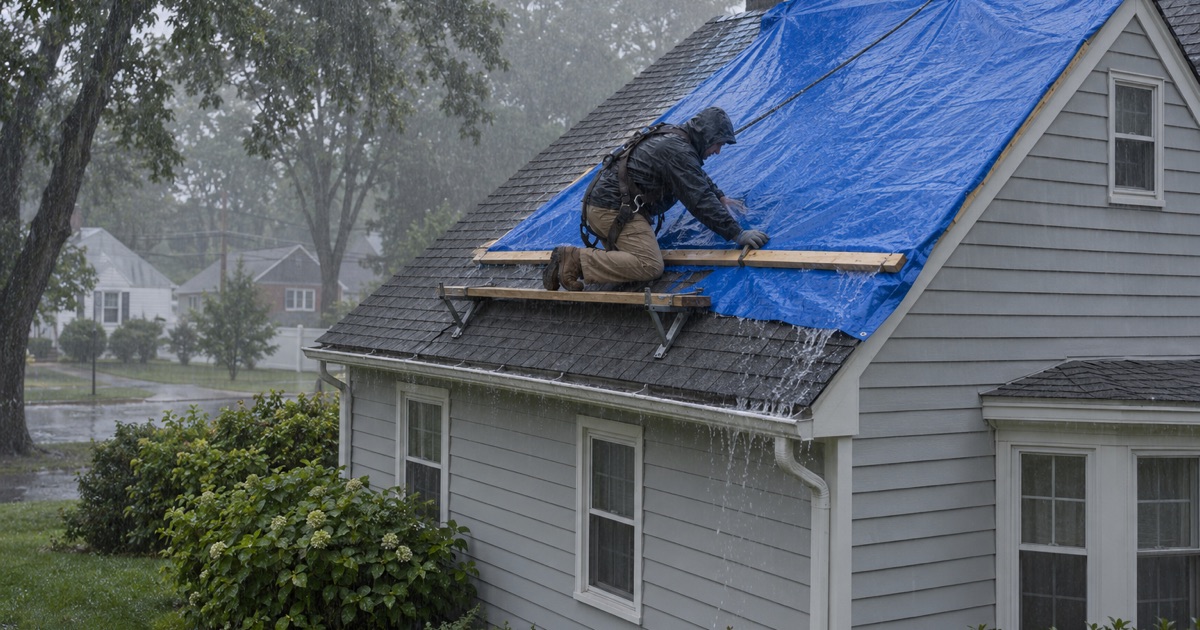
A tarp only works when it is fastened properly. We run it over the ridge where possible so water cannot get under the top edge, secure it with battens rather than loose nails, and extend it well past the damaged area. A tarp held down with a few bricks will blow off in the next gust and let the water back in.
For small openings, a temporary patch of underlayment and shingles or a sheet of plywood may be better than a tarp. We choose the cover that will hold until the permanent repair.
Every fastener we drive for a temporary cover is a hole the permanent repair will have to deal with, so we place them where the roofing is already damaged or will be replaced. The goal is to protect the house without creating new leak points in sound sections of the roof.
Stopping Interior Damage
Inside, move furniture and electronics away from the water, catch drips in buckets, and if a ceiling is bulging with water, puncture it at the lowest point to drain it in one place. Turn off power to any light fixture in the wet area. These steps limit how much drywall and insulation will need replacing later.
Common Roofing Emergencies
Fallen Trees and Limbs
A limb through the roof can break rafters and decking, not just shingles. Once the debris is removed we inspect the framing, cover the opening and plan a repair that replaces the damaged structure, decking, underlayment and shingles, matched to the surrounding roof as closely as possible.
If rafters or trusses are cracked, the repair becomes structural. Depending on the extent of the damage and the type of building, that work may need a construction permit and inspection even where a simple re-roof would not. We tell you when that line has been crossed and handle the township paperwork as part of the job.
Wind Damage
Strong gusts can strip shingles, tear off ridge caps and lift flashing. The exposed underlayment may hold for a short time, but it is not designed to be the outer surface. We cover the exposed areas, hand-seal loose tabs nearby and replace missing shingles once the weather allows.
Shingles next to a blow-off often look intact but have lost their seal strip, which means the next storm will take them too. We lift-test the surrounding tabs during the permanent repair and reseal or replace any that have let go, so the repair does not become the edge of the next blow-off.
Skylight and Chimney Failures
A cracked skylight dome, a seal that lets go in a downpour or chimney flashing that tears loose in a gust can all turn into emergencies. We cover the opening or flash it temporarily, then plan the right permanent fix, whether that is new flashing, a rebuilt chimney cap or a replacement skylight.
Sudden Leaks in Heavy Rain
Sometimes there is no visible damage, just water pouring through a ceiling during a downpour. We trace the leak from the attic and the roof, make a temporary seal at the source if conditions allow, and return for the permanent repair to the flashing, boot or shingles that failed.
Ice Dam Leaks
In winter, an ice dam along the eave can push meltwater into the house within hours. We relieve the immediate pressure carefully, without chopping at the ice in ways that damage the shingles, and then address the insulation and ventilation conditions that caused the dam.
After the Emergency
Documentation for Your Claim
We photograph the damage before and after the temporary repair and give you a written description you can send to your insurer. If you ask, the crew will meet the adjuster on site to show what was found. We do not negotiate the claim; that belongs to you, the adjuster or a licensed public adjuster.
Planning the Permanent Repair
Once the roof is covered and the adjuster has seen it, we write up the permanent repair with each part of the work listed. If the damage is limited, that is a repair. If the roof was already near the end of its life, we tell you so honestly, because insurance generally covers storm damage rather than age.
Watch for Storm Chasers
After major storms, out-of-area contractors often go door to door. In New Jersey, a home improvement contractor must be registered under the Contractors’ Business Registration Act, and contracts carry a three-business-day cancellation right. Ask for the registration number before signing anything, whoever you hire.
Be cautious of anyone who offers to handle your claim for you or promises to cover your deductible. In New Jersey only a licensed public adjuster may negotiate a claim on a homeowner’s behalf under N.J.S.A. 17:22B, and a contractor offering to do so is a warning sign.
Flood-Prone Neighborhoods
Parts of Hamilton along the Assunpink Creek have flooded in past storms, including Cornell Heights after Hurricane Irene in 2011. When a storm brings both roof damage and flooding, the roof repair is only part of the recovery. We work around flood cleanup crews and keep our documentation separate so each claim is clear.
- 20+ Years on the Roof
- Free Written Estimates
- NJ and PA Contracts