
Hamilton Elite Roofing repairs flat roofs across Hamilton, NJ, and our crews handle low-slope work in Burlington, Mount Holly, Bordentown Township and Florence as well. In over two decades of roofing we have patched, re-seamed and re-flashed the low-slope sections that so many houses and small buildings carry: porch roofs, garage roofs, rear additions, row homes and storefronts.
Flat roofs are not truly flat. They are built with a slight pitch so water runs to drains, scuppers or gutters. When that drainage fails, water stands on the membrane and finds every weak seam, so most flat roof repairs start with understanding where the water is supposed to go.
We identify the membrane before choosing a repair. Modified bitumen, EPDM rubber, TPO and PVC each bond to different materials, and a patch made with the wrong product peels off within a season.
Flat Roof Membranes and Their Repairs
Modified Bitumen
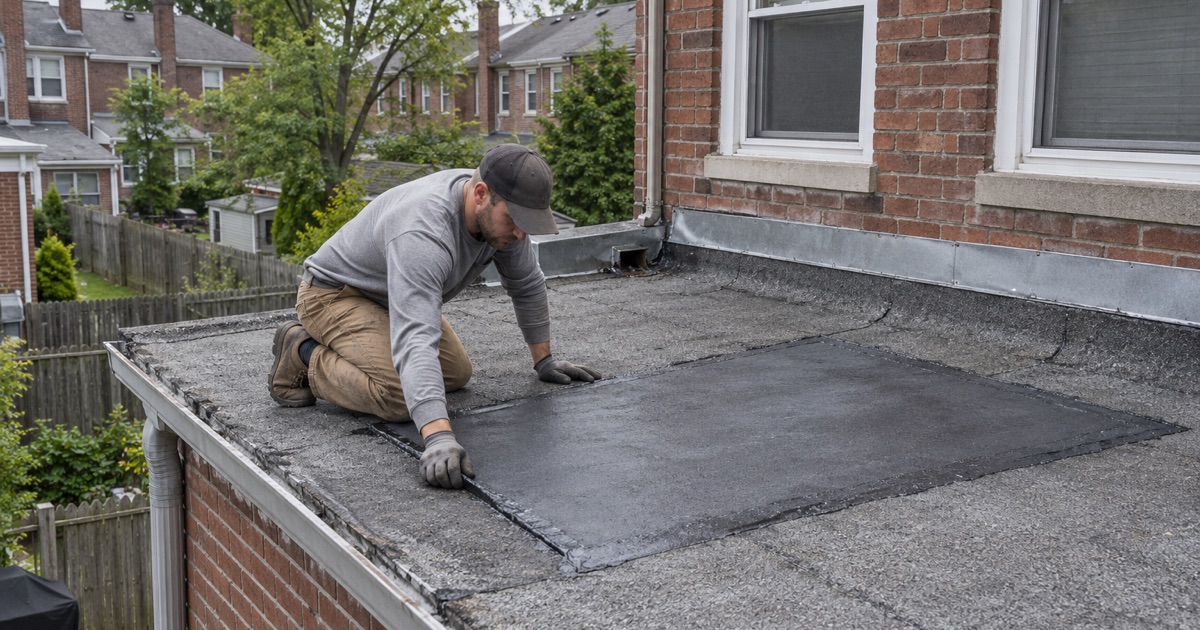
Torch-down SBS and APP modified bitumen are common on row homes, older commercial blocks and porch roofs. They fail at laps that were never fully sealed, at blisters where moisture got trapped beneath the sheet, and at flashings along walls. We cut out blisters, torch or adhere new cap sheet over damaged areas, and rebuild wall flashings with new base and cap plies.
Where a torch is unsafe near wood trim or occupied spaces, we use cold-applied or self-adhered modified bitumen instead. The finished repair performs the same way, and nobody has to worry about an open flame next to a frame wall.
EPDM Rubber
EPDM is a black synthetic rubber membrane that ages slowly but tends to leak at seams where the original adhesive has dried out, and at punctures from foot traffic or fallen branches. We clean and prime the rubber, then apply seam tape or a cured EPDM patch, rolled down firmly so it bonds across its full width.
Older EPDM roofs sometimes shrink, pulling away from walls and edges and leaving the membrane stretched taut at corners. That shrinkage tears flashings and can lift edge metal. We re-terminate the membrane at those points and add new flashing strips to restore the seal.
TPO and PVC
TPO and PVC are single-ply membranes with heat-welded seams. Repairs involve cleaning and preparing the surface and welding a patch of the same material over the damage with a hot-air tool. A cold or incomplete weld is a common cause of leaks on these roofs, and we probe every seam in the area of a leak before deciding what to fix.
Where Flat Roofs Leak
Ponding and Drainage
Standing water that remains days after rain adds weight, accelerates wear on the membrane and keeps pressure on any open seam. Clogged drains and scuppers are the most common cause, followed by gutters that are too small or a deck that has sagged. We clear the drainage path first, then decide whether tapered insulation or a cricket is needed to move water off a low area.
Walls, Parapets and Edges
Where a flat roof meets a wall, the membrane turns up and is covered by counter flashing or a termination bar. Those flashings crack, pull away or were never tall enough. At the roof edge, metal drip edge and gravel stops loosen. Leaks at these points often show up inside along exterior walls, and we rebuild the termination rather than caulking over it.
Parapet walls add their own problems: cracked coping stones, open mortar joints and through-wall leaks that look like roof leaks. We check the wall and its cap as well as the membrane.
Penetrations and Equipment
Vent pipes, exhaust fans, skylights and air conditioning units all pass through the membrane. Each needs a boot, curb or flashing designed for that membrane type. Pitch pans filled with old sealant are a frequent leak source, and where possible we replace them with prefabricated boots that seal more reliably.
Flat Roofs on Houses
Porch and Addition Roofs
Many Hamilton houses have a low-slope porch roof or rear addition attached to a pitched main roof. The joint where the two meet is where most of these leaks start. We flash the transition so water from the main roof lands on the flat section without running under it, and we check that the porch roof drains away from the house.
Garages and Row Homes
Detached garages and row homes often carry modified bitumen or EPDM that has been patched many times. We assess whether the remaining membrane is worth repairing, and when it is, we make one proper repair rather than adding another layer of patches to the stack.
Row homes add the complication of shared roofs. The membrane on one house often runs continuously into the next, and a leak on your side may start on your neighbor’s. We trace the water across the party wall line where we can, explain what we find, and plan any repair that crosses the line with both owners in mind.
Mixed-Use Buildings With Apartments Above
A flat roof over apartments or a storefront needs fast, careful work because a leak reaches people’s homes and businesses. We schedule repairs around tenants, keep the work area tidy, and give the owner photographs and a short written record of what was repaired for the building file.
Repair, Coat or Replace
Judging the Membrane
A membrane with isolated problems and dry insulation beneath is a good candidate for repair. When leaks show up in many places, the membrane is brittle or blistered across the field, or the insulation below is wet over large areas, repairs only delay a replacement. We cut a small test opening where needed to check the insulation, and we show you what we find.
Where Coatings Fit
Reflective coatings can extend the life of a sound membrane and lower rooftop temperatures. They need a clean, dry surface and a product compatible with the membrane. On a roof with wet insulation or failed seams, a coating traps the problem underneath, so we only recommend one after the roof has been repaired and confirmed dry.
Permits on Flat Roof Work
Repairs to the roof covering on a detached one- or two-family house fall under New Jersey’s ordinary-maintenance rule and do not need a permit. Flat roofs on attached homes, apartment buildings and commercial properties are outside that rule, and we check the requirement with the township before larger work on those buildings.
- 20+ Years on the Roof
- Free Written Estimates
- NJ and PA Contracts