
Hamilton Elite Roofing repairs chimneys where they meet the roof in Hamilton, NJ, and we serve homeowners in Robbinsville, Lumberton, Florence and Bordentown Township too. Over more than 20 years we have found that the chimney is the single most common source of roof leaks on older houses, and most of those leaks come from the flashing rather than the brick.
A chimney and a roof move independently. The masonry stays put while the roof framing expands, contracts and settles, and the flashing between them has to absorb that movement without letting water in. When it was installed poorly, reused from an earlier roof or sealed with nothing but caulk, it fails.
We repair the flashing, the cricket behind the chimney, the crown and cap on top, and the mortar joints in between. Structural rebuilds and flue liners belong to masonry and chimney specialists, and we tell you plainly when a chimney needs one.
Chimney Flashing Repair
Step and Counter Flashing
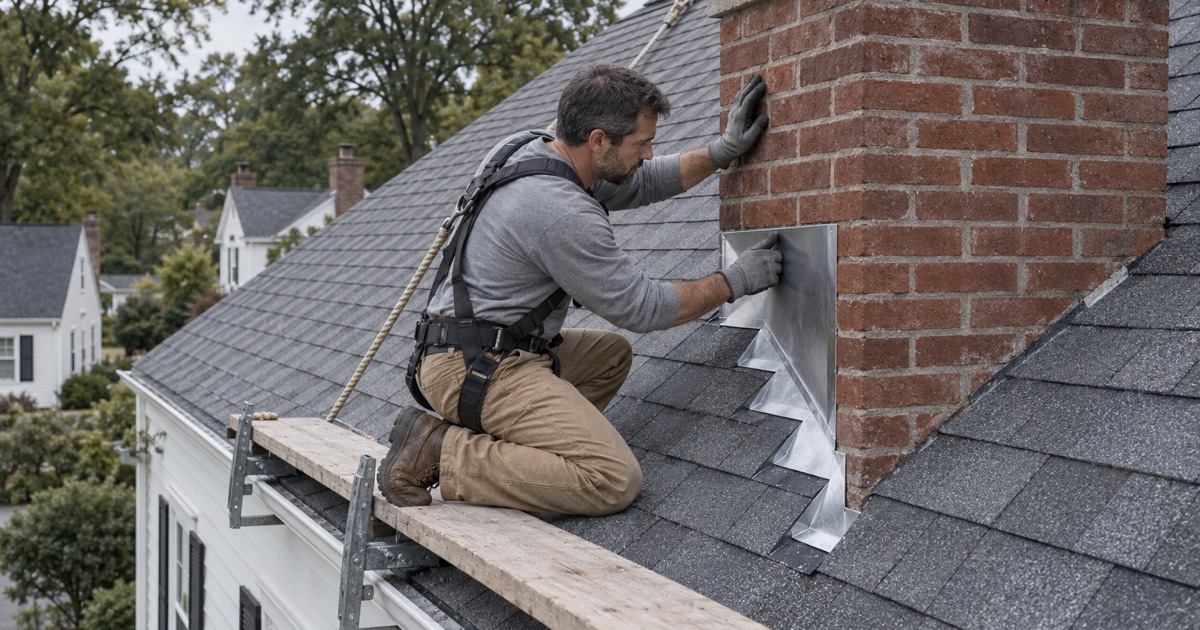
Proper chimney flashing has two layers. Step flashing is woven into each course of shingles along the sides of the chimney, and counter flashing is set into the masonry and laps down over the step flashing. The two overlap without being fastened together, which lets the roof and chimney move without tearing the seal.
When we replace chimney flashing, we lift the surrounding shingles, install new step flashing course by course, and cut a reglet into the mortar joint to seat new counter flashing. The reglet is sealed with a compatible sealant, but the sealant is not doing the waterproofing; the lapped metal is.
Apron Flashing at the Front
On the downhill side of the chimney, apron flashing carries water from the face of the masonry out over the shingles below. When it is too short or has lifted, water runs under the shingles at the front of the chimney. We replace the apron in one piece, bent to the roof pitch, with the counter flashing above it.
Fixing Caulk-Only Repairs
Many chimneys we see have been repaired with roofing cement or caulk smeared over the joint. It works for a season or two, then cracks as the materials move and the sun dries it out. We remove those patches, clean the masonry and install real flashing, which is the only repair that lasts.
Where a past roofer face-nailed flashing to the brick or ran shingles up the chimney face, we undo that work too. Fasteners in the face of the masonry crack the brick, and shingles against a vertical surface trap water rather than shed it.
Crickets Behind Wide Chimneys
Why a Cricket Matters
The back of a chimney faces uphill, so every drop of water running down the roof above it hits the masonry and pools there. Leaves and debris collect in the same spot. A cricket, also called a saddle, is a small peaked roof that splits the flow around the chimney so nothing sits against the back.
IRC R1003.20 calls for a cricket behind chimneys wider than 30 inches measured across the roof. Many older Hamilton houses have wide chimneys built without one, and they leak at the back corners in heavy rain.
Building and Flashing a Cricket
We frame the cricket on the roof deck, sheathe it, cover it with self-adhering ice and water barrier, and then roof it with shingles or metal to match. The valleys where the cricket meets the main roof are flashed like any other valley, and the back of the chimney gets new counter flashing over the cricket.
Adding a cricket during a full roof replacement is the most efficient time, because the shingles are already off. It can also be added on its own when a leak at the back of the chimney keeps returning after flashing repairs.
Crowns, Caps and Masonry
Chimney Crowns
The crown is the concrete or mortar slab that caps the top of the chimney around the flue. When it cracks, water goes straight down into the masonry, softening mortar and eventually staining walls and ceilings inside. Small cracks can be sealed with a crown repair compound; a crown that is crumbling or was built too thin needs to be recast.
A proper crown slopes away from the flue and overhangs the brick slightly, so water drips clear of the chimney face instead of running down it. Many original crowns were simply troweled mortar with no overhang at all.
Chimney Caps
A cap sits over the flue opening to keep rain, snow, animals and debris out. Without one, water falls directly down the flue and can damage the damper and firebox. We install stainless or galvanized caps sized to the flue and fastened securely so wind cannot lift them.
Repointing Mortar Joints
Mortar wears faster than brick. Once the joints erode, water soaks into the masonry and freezing weather pushes the bricks apart from within. Repointing removes the deteriorated mortar to a set depth and replaces it with new mortar compatible with the original, which keeps the chimney sound and stops water traveling through it.
On older chimneys we match the mortar to the brick rather than using a hard modern mix that can damage softer historic brick. Spalled or broken bricks on the roof side of the chimney can be replaced individually during the same visit.
Chimney Repair With a New Roof
Planning Both Together
When a roof is being replaced, the chimney flashing comes off anyway. That is the right time to repoint the joints above the roofline, recast a failing crown, add a cricket if the chimney is wide enough to need one and install new step, counter and apron flashing. Doing it all at once avoids disturbing new shingles later.
Older Homes and Lead-Safe Work
More than a fifth of Hamilton’s homes were built before 1950, many with masonry chimneys from that era. If painted trim around the chimney chase on a pre-1978 house has to be disturbed, the work follows the EPA RRP lead-safe rule, and we plan it that way from the start.
- 20+ Years on the Roof
- Free Written Estimates
- NJ and PA Contracts